
Growth Mapping: turning a small business’s real numbers into the next right move
TL;DR: Growth Mapping is a closed-loop system that turns a small business’s real financial and marketing data into a prioritized set of actions. It is grounded in Teece’s dynamic capabilities theory — Sense, Seize, Transform — organized across three operational domains (Recruitment, Retention, Revenue) and ranked by three business dimensions (Profit, Potential, People). It is not a customer-profiling exercise. It is not a dashboard. It is a decision engine bound to what your clients are actually worth and what it costs to serve them.
Abstract
Most small businesses do not have a marketing system. They have marketing activities. They have reports. They have a vague sense that some of it is working and a sharper sense that they cannot prove which part. This paper defines Growth Mapping — a framework drawn from doctoral research at the University of British Columbia (Okanagan) — as a rigorous, closed-loop approach to small-business growth strategy. It grounds the framework in dynamic-capabilities theory (Teece, 2007), draws on Bohnsack and Liesner’s (2019) growth-hacking taxonomy to structure the Plays catalog, and argues that the only sustainable moat a small business has is a system that reads its own numbers, acts on them, and measures what moved. The commercial embodiment of this research is the Hiilite Agentic Advisor. The thesis behind both is the same: a reporting tool tells you what happened; a growth-mapping system tells you what to do next.
Why the term “Growth Mapping” needs a rigorous definition
Three marketing agencies already use the phrase “Growth Mapping.” All three use it to mean customer profiling — segmenting an audience, mapping a journey, identifying a persona. That is useful work. It is not Growth Mapping in the sense this paper defines.
The confusion matters. When a small-business owner hears “growth mapping,” they should understand something with more teeth: a decision system that takes their actual revenue data, their customer numbers, their cost structure, and their marketing performance, and produces a ranked, defensible answer to the question “what do we do next to grow?”
Customer profiling is an input to that system. It is not the system itself.
This paper claims the definition. Growth Mapping is a dynamic-capabilities-grounded, data-bound, closed-loop growth system for small and medium enterprises. It is organized around the 3Rs (Recruitment, Retention, Revenue), ranked by the 3Ps (Profit, Potential, People), and powered by a continuous Sense-Seize-Transform loop tied to real financial and marketing data.
Everything else using the term is describing something smaller.
The problem this solves (and why it hits small businesses hardest)
ISED’s Key Small Business Statistics 2025 reports that small businesses make up 98.2% of all employer businesses in Canada. Most growth frameworks, tools, and playbooks are not built for them. They are built for well-capitalized startups chasing exponential curves or for enterprise marketing teams with a dedicated analyst and a six-figure technology budget.
The result is a gap: 92% of new businesses fail within three years (Pride and O’Reilly, 2018, Unicorn Tears), and a significant share of that failure is traceable not to the absence of effort but to the absence of a system that connects effort to outcomes.
Owners feel this problem in very specific ways. Research on small-business owner frustrations reveals a consistent pattern:
- “The biggest difficulty about marketing is measuring your ROI on any platform. There are just so many intangibles.” — Rudy Dory (Alignable)
- “I have a small budget so can’t afford to blow it on something that doesn’t work.” — Ariann Thomas (Alignable)
- “Lack of proactively managing campaigns and making recommendations to improve results — also known as ‘set it and forget it.'” — Kevin Whelan (Alignable)
These are not complaints about execution quality. They are complaints about the absence of a system. The owner does not know if it is working. The agency does not tell them. The reports show what happened but not what to do. This is the fundamental problem Growth Mapping is built to solve.
The third-party data corroborates it: Funnel.io’s marketing-reporting research found that 80%+ of marketers surveyed lack a clear signal for what is working, and 41% report results without analyzing the “why.” That is not a technology problem. It is a framework problem.
The theoretical foundation: dynamic capabilities
Growth Mapping is built on David Teece’s theory of dynamic capabilities — specifically the tripartite framework he articulated in his 2007 Strategic Management Journal paper (doi:10.1002/smj.640) and extended in his 2018 Long Range Planning piece (doi:10.1016/j.lrp.2017.06.007).
Teece’s argument is this: in a competitive environment that changes faster than any fixed strategy can accommodate, the advantage belongs to firms that can sense opportunity and threat before competitors do, seize the right opportunities with speed and decisiveness, and reconfigure (transform) their assets and activities when the evidence says the current configuration is wrong.
These three capabilities — Sense, Seize, Transform — are not sequential phases in a project. They are a continuous loop. The firm that runs the loop faster and more accurately than its competitors compounds a structural advantage that is genuinely difficult to replicate, because the capability is in the system, not in any single decision or tactic.
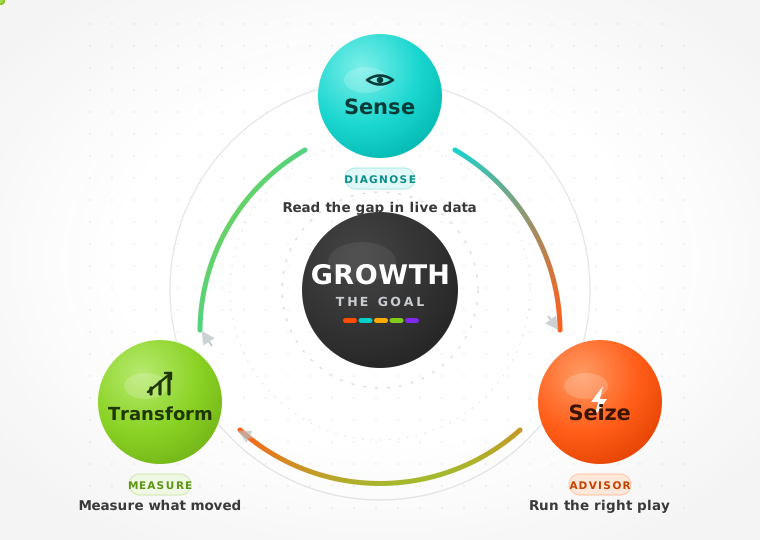
The academic community has largely applied dynamic capabilities to large firms and M&A contexts. The Growth Mapping research applies it at the SME level, where the stakes are more immediate and the data is more tractable: one business, real numbers, real decisions, real outcomes.
For a small business: – Sense means reading the live data — revenue trends, client counts, marketing performance, profitability — and identifying the gap between where the business is and where it wants to be. – Seize means selecting and sequencing the specific marketing actions (Plays) that close that gap, ranked by projected impact. – Transform means measuring what actually moved, attributing it honestly, and feeding that back into the next Sense cycle.
This is not a metaphor. It is the architecture of the Hiilite Agentic Advisor, built as the knowledge-mobilization deliverable of the PhD research.
Growth Hacking: a taxonomy, not a bag of tricks
“Growth hacking” is a term Sean Ellis coined in 2010 to describe the mindset of early-stage startups that prioritized growth above everything else and ran rapid, low-cost experiments to find it. The term has since been diluted by a thousand listicles and “growth hack your business” promises that reduce it to a set of tactics divorced from any analytic or strategic framework.
The research base is more interesting than the popular usage.
Bohnsack and Liesner (2019), in their Business Horizons taxonomy (doi:10.1016/j.bushor.2019.09.001), classify growth-hacking interventions by mechanism, data requirement, and stage-fit. Their work is the academic grounding for what Growth Mapping calls the Plays catalog — the structured library of repeatable marketing interventions, each tied to a domain (Recruitment, Retention, or Revenue), a measurable outcome vector, and a data requirement for knowing if it worked.
Troisi et al. (2019), in Industrial Marketing Management (doi:10.1016/j.indmarman.2019.08.005), extend this into B2B and relationship contexts, reinforcing that the mechanism matters as much as the tactic.
The Growth Mapping synthesis: growth hacking without a loop is just guessing faster. The Plays catalog gives you the moves. The Sense-Seize-Transform loop gives you the judgment about which move to run, when, against which goal, and how to know if it worked.
The framework: 3Rs, 3Ps, and the Growth Map
Growth Mapping organizes all marketing activity across two complementary structures.
The 3Rs: the operational domains
Every marketing action a business can take falls into one of three domains:
- Recruitment — acquiring new clients or customers: SEO, advertising, referrals, outreach, conversion.
- Retention — keeping and expanding existing relationships: onboarding, lifecycle communication, upsell, community, churn prevention.
- Revenue — making the business more profitable per client: pricing, packaging, mix optimization, offer structure, profitability analysis.
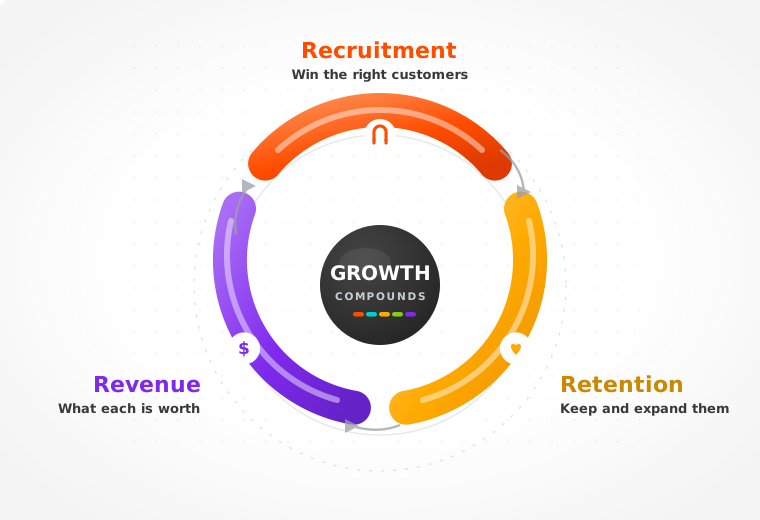
These three domains are not a funnel. A business’s growth constraint is usually concentrated in one of them at any given time. The Sense phase identifies which one. The Seize phase selects the Plays within that domain. The 3Rs ensure no domain gets ignored and that the system does not mistake activity in the easy domain for progress in the constrained one.
Most small businesses over-index on Recruitment and under-invest in Retention and Revenue — in part because acquisition is visible (clicks, leads, impressions) and retention is slow and quiet (churn, LTV, profitability per relationship). Growth Mapping makes all three legible.
The 3Ps: the ranking rubric
Within any domain, there are usually more Plays available than resources to run them. The 3Ps provide the ranking logic for which Play to run next:
- Profit — does running this Play improve or protect the business’s profitability? What does it cost to execute, and what is the projected return at the current client economics?
- Potential — what is the growth ceiling of this Play? A tactic that works but has a hard ceiling (geographic, seasonal, audience-size) scores lower than one that compounds.
- People (Culture) — does the business have the capability, the team bandwidth, and the operational readiness to execute this Play well? A high-ceiling play that the team cannot run to standard is worse than a lower-ceiling play that they can execute at full quality.
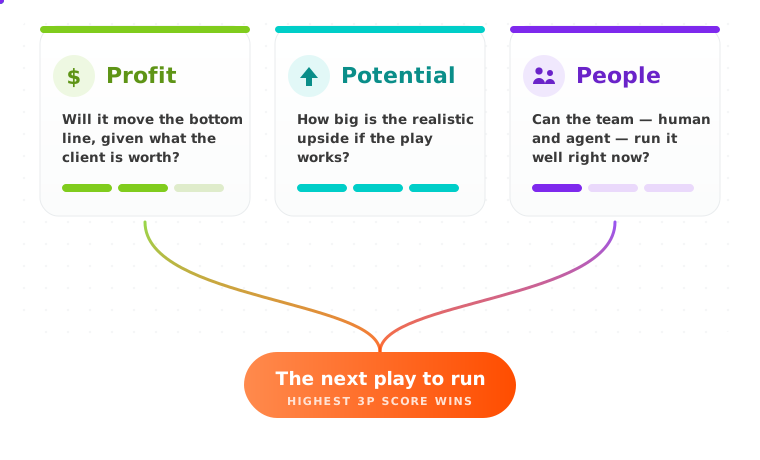
These three dimensions together produce a ranked order. The top-ranked Play, grounded in real financial data, is the next right move.
The Growth Map
The Growth Map is the visualization of this framework in action: the KPIs across the three domains, plotted as directional vectors showing current trajectory versus goal. A business’s Growth Map shows not just where it is but which direction it is moving in each domain, and how far the current trajectory lands from the declared goal.
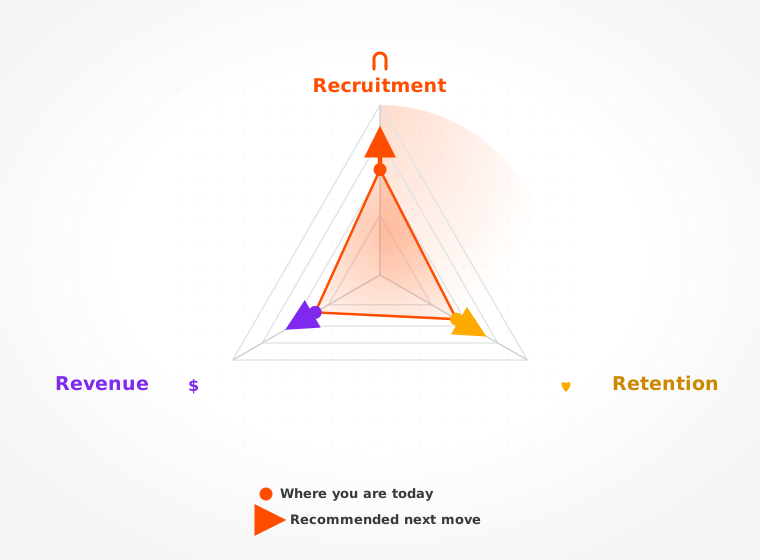
It is the diagnostic surface the Sense phase produces. It is what makes the Seize recommendation defensible — not “we think you should try SEO” but “your Recruitment domain is below target by 23% and your top-ranked Play in that domain, given your current profitability and team bandwidth, is organic search.”
The moat: why this is hard to copy
Porter’s “What Is Strategy?” (HBR, 1996) argues that sustainable competitive advantage comes not from running individual activities well but from systems of interlocking activities that reinforce each other. A competitor can copy any single activity. They cannot easily copy the whole system.
Growth Mapping’s moat is exactly this: the loop is only as good as the data it runs on, and the data that makes it real — proprietary client financials — is not available to any generic reporting tool or open-loop skills library.
Reporting tools are read-only. AgencyAnalytics, Whatagraph, DashThis: these show what happened. They do not tell you what to do next. They do not connect to the money.
Skill libraries are open-loop. A curated library of 50 marketing tactics has no goal, no client data, and no feedback mechanism. It is a toolbox without a blueprint.
Hiilite closes the loop, bound to real financials. The platform connects GA4, Search Console, and SE Ranking (marketing performance) to QuickBooks revenue (what the client is worth), Everhour hours and cost (what it costs to serve them), and CRM pipeline (where the book of business is going). Recommendations are grounded in both what is working and what is profitable.
The wedge line: your report knows what each client is worth.
No competing reporting tool makes that statement true. It requires both the marketing data and the financial data in one system, with a Sense-Seize-Transform loop that does something with the connection. That system is Growth Mapping in production.
This is also why the framework’s academic grounding matters. Kalaignanam et al. (2021), in the Journal of Marketing (doi:10.1177/0022242920952760), show that marketing agility — the capacity to sense and respond faster than competitors — is a measurable source of firm performance, not just a metaphor. The Growth Mapping loop is the operationalization of that finding at the SME scale.
The SME mission
It is worth being clear about why this research is focused on small businesses specifically, rather than the enterprise or startup contexts that most strategy literature addresses.
Small businesses make up 98.2% of all employer businesses in Canada. They employ the majority of the private-sector workforce. They are the economic substrate of every small city and every community. And they are systematically underserved by the tools, frameworks, and advisors that exist in the market — most of which are either priced for enterprise budgets or designed for venture-backed startups chasing exponential growth curves.
The 92% failure rate within three years is not primarily a capital problem or an idea problem. A meaningful share of it is a decision-quality problem: owners who cannot tell which marketing activities are working, cannot connect their marketing spend to their financial outcomes, and cannot get a clear answer to the question “what should I do next?”
Growth Mapping is an attempt to give small businesses the same decision-quality infrastructure that well-resourced firms take for granted — without requiring a data science team, a six-figure analytics budget, or a graduate degree to use it.
The system does that work. The owner runs the business.
From research to platform
The Hiilite Agentic Advisor is the knowledge-mobilization deliverable of the Growth Mapping research. The PhD’s promised “Growth Mapping Digital Tool” is already built and running in production at metrics.hiilite.com.
The platform’s architecture maps directly to the framework:
- The Diagnose agent = Sense: it reads the live data across all sources and produces the current Growth Map.
- The Advisor agent = Seize: it recommends and sequences the next Plays, ranked by the 3Ps, with projected impact grounded in the client’s actual financials.
- The measurement loop = Transform: every Play that runs produces a measurement event that feeds back into the next Sense cycle.
The Plays catalog is the growth-hacking taxonomy from the academic literature, productized: each Play specifies its domain (3R), its mechanism, its data requirement, and its outcome metric. Running a Play is a testable intervention, not a guess.
The platform and the research iterate together. The platform is the research instrument; the study validates the recommendation engine; the engine improves from the study. This is not two separate projects — it is one system with an academic leg and a commercial leg, reinforcing each other.
For more on how the agent architecture works and what makes this different from a standard agency model, see the companion paper: The Agentic Agency.
For the full framework — the interactive Growth Map, the 3R/3P model, and the Plays taxonomy — see the Growth Mapping framework page.
Proving it moved: the counterfactual
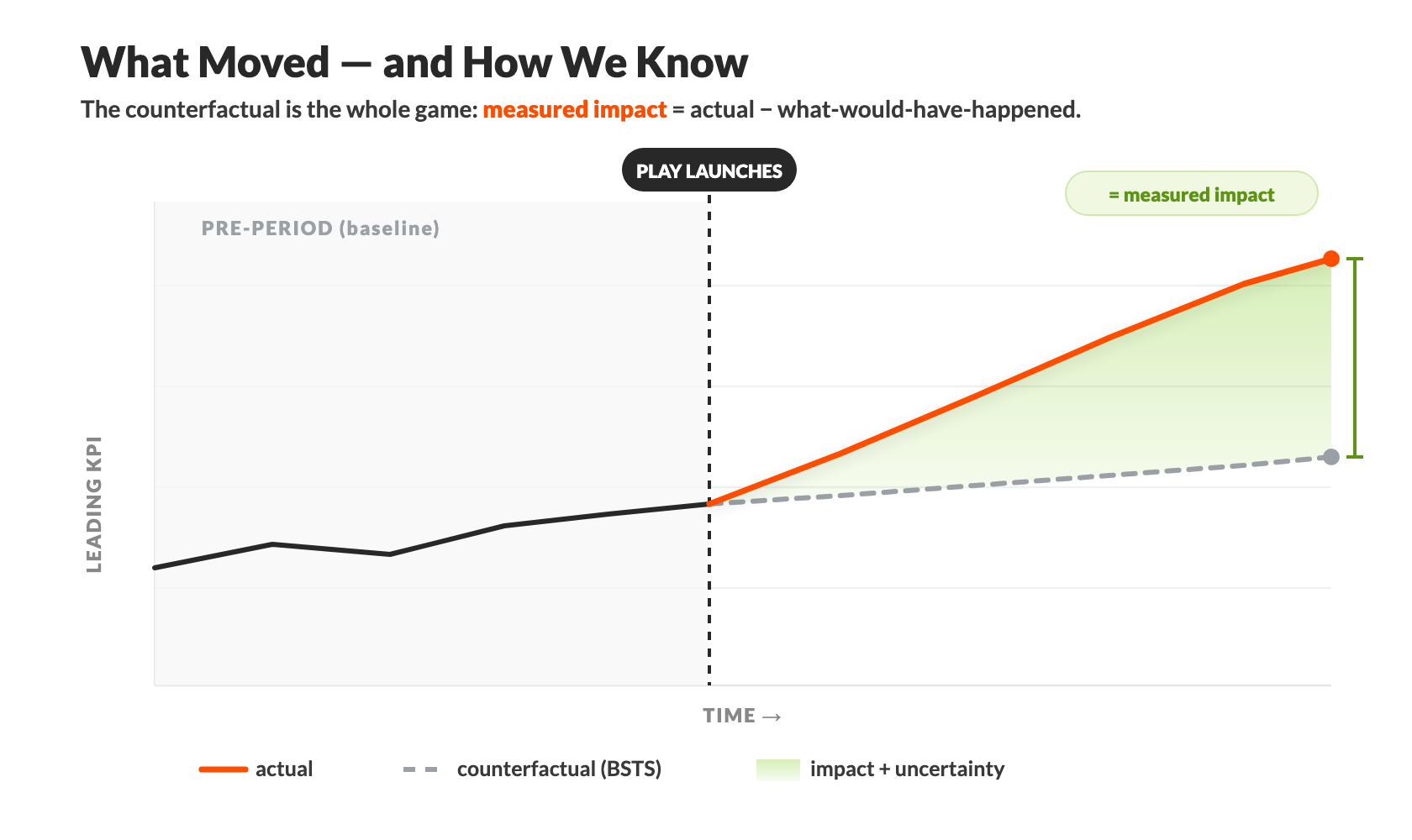
Most marketing “measurement” is a before-and-after screenshot. The number went up after we did the thing, so the thing worked. That reasoning quietly assumes nothing else changed — but Google shipped an algorithm update, it was the busy season, a competitor paused their ads. A real measurement answers a harder question: what would have happened without the Play?
Growth Mapping treats every Play as three questions, not one. Estimate its likely impact before it runs, as a range — that ranking is how the Advisor decides what to do next. Measure what actually moved after, against a modeled counterfactual — the honest “what would have happened anyway,” subtracted out. Explain why the same Play lands differently for different businesses, so the lesson transfers to the next one.
The counterfactual is the whole game. Depending on what data a business has, it is built different ways — comparing a treated channel against a held-back one, modeling the baseline from correlated signals, or reconstructing a synthetic “twin” from comparable firms. The rigor scales to the evidence, and the honest uncertainty travels with the number instead of hiding behind it. That is the difference between a dashboard that shows what happened and a system that proves what you caused. (This is the methods core of the underlying PhD research; the full identification strategy is the dissertation’s methods chapter.)
FAQ
Q: Isn’t “Growth Mapping” just customer journey mapping with a different name?
No. Customer journey mapping documents how a customer moves from awareness to purchase — it is a research and experience-design tool. Growth Mapping is a decision system for what marketing actions to run next, ranked by projected financial impact. Journey mapping might be an input to a Recruitment Play. It is not the system that decides whether to run that Play, in what sequence, or whether it moved the numbers.
Q: Can a small business use this without the Hiilite platform?
The framework — the Sense-Seize-Transform loop, the 3Rs, the 3Ps — can be applied with a spreadsheet and discipline. The loop still needs data: revenue numbers, client counts, cost-per-acquisition, profitability by relationship. What the platform does is automate the Sense phase (pulling and synthesizing that data continuously), de-risk the Seize phase (grounding recommendations in real financials rather than intuition), and close the Transform phase (measuring what moved against the declared goal). The framework has value without the platform. The platform makes the framework fast, defensible, and compounding.
Q: How is this different from just tracking KPIs?
KPI tracking is Sense without Seize or Transform. It tells you where you are. Growth Mapping tells you where you are, which direction to move, which specific actions move you in that direction fastest given your current financials, and whether those actions actually moved you. A dashboard is a rear-view mirror. Growth Mapping is a navigation system.
Q: How do you know the Play caused the result, and not just coincidence?
This is the question most marketing reporting quietly skips. We don’t compare “before” to “after” and call it proof — too many things move at once (seasonality, algorithm updates, competitor moves). Instead, each Play is measured against a counterfactual: a modeled estimate of what the metric would have done without it, subtracted from what actually happened. The leftover is the real effect, reported with its uncertainty. Where the data supports it, the comparison is pre-registered before the Play runs, so the result cannot be reverse-engineered to look good after the fact.
Q: Why ground this in Teece’s dynamic capabilities rather than a simpler framework?
Because dynamic capabilities theory is the right level of precision for the problem. It distinguishes between operational capabilities (doing known things well) and dynamic capabilities (sensing, seizing, and reconfiguring when the environment changes). A small business that only has operational capabilities — a good product, a capable team, reliable execution — will still stall when the market shifts. The Growth Mapping loop builds the dynamic capability: the ability to read the environment continuously and adjust. That is not a feature of simpler frameworks. Teece gives us the vocabulary and the theoretical backing for why the loop compounds into advantage over time.
Q: What does the research study look like?
The Growth Mapping PhD research is a mixed-method study at UBC-Okanagan, under the supervision of Dr. Eric Li. It studies how small businesses use growth-hacking interventions and whether a systematic, data-bound approach to selecting and sequencing those interventions produces better outcomes than ad hoc execution. The platform serves as the research instrument: it delivers the interventions, logs the growth-hack events, and pulls the KPI panels the study needs. Findings will be published following BREB approval and study completion. The platform is live and operational independent of the academic timeline.
Author
William Walczak is the CEO of Hiilite Creative Group and a PhD candidate in Interdisciplinary Graduate Studies at UBC-Okanagan, supervised by Dr. Eric Li. His research sits at the intersection of growth hacking, dynamic capabilities, and predictive analytics for small and medium enterprises. He holds an MBA from UBC and a degree in Engineering from Simon Fraser University. He was named Marketing Strategy CEO of the Year 2023 (BC) by CEO Monthly and a Daily Courier Top 40 honoree.
Peer-reviewed publication: Walczak, W., Li, E. P. H., and Nelson, S. (2024). “Logarithm: A Cinematic Exploration of Time.” Journal of Customer Behaviour.
Connect: hiilite.com/team/william-walczak · linkedin.com/in/williamwalczak · Google Scholar
What to do next
If you are running a small business and you want to see what your Growth Map looks like, the framework page walks through the 3R/3P model and the diagnostic logic in plain terms.
If you want to know whether your marketing is actually profitable — and what to do next if it is not — book a discovery call with the Hiilite team.
The loop closes on real numbers. Let us run it on yours.
Related: The Agentic Agency: how AI agents change what a marketing agency can be